



Megalithism is a building practice that appears to have emerged in Europe around the sixth millennium BCE. Megalithic cultures emerged in Western Europe during the Neolithic period and refers to that phase of human history which, after the last Ice Age, began to reclaim the European grasslands freed from the ice by marking the landscape with huge stones. The main traces of these works have been found in the British Isles, along the Atlantic coasts, and in the Mediterranean. Although several megaliths also appeared inland, this practice left numerous marks along the coastlines or on the hills overlooking them, as if to unite not only the earth with the sky, but likely also the limit that defines a passage between worlds—the sea coast.
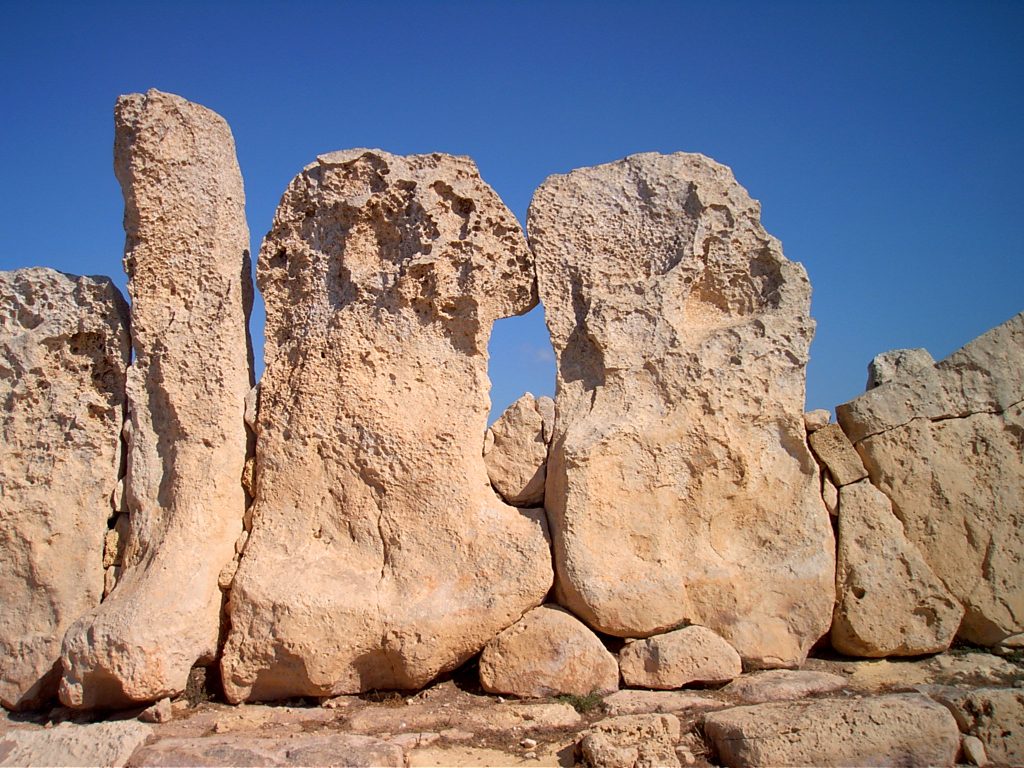
For over twenty years we have been traveling to visit megalithic sites: Crete, Malta, Greece, Portugal, Spain, southern Italy, England, Ireland, and Scotland. Soon it will be France’s turn, specifically Morbihan: The Megaliths of Carnac and the shores of Morbihan were officially inscribed as a UNESCO World Heritage Site on July 12, 2025.
Hagar Qim, Malta – Credit: Massimo Frera, 2004
In our view, this recognition is fundamental to reaffirming the memory of what once was: in Europe, the impact of Christianity was devastating when it came to erasing historical memory. After her conversion to Christianity, Flavia Giulia Elena (later Saint Helena- Sant’Elena), mother of Emperor Constantine I, went on a pilgrimage to the Holy Land and ordered the destruction of pagan temples built over sacred sites (such as the Temple of Aphrodite in Jerusalem) to erect the first Christian basilicas. She thus paved the way for a practice that, shortly after under Theodosius I, culminated in the Edict of Thessalonica in 380 CE: Christianity became the official state religion, and, above all, the destruction of pagan temples and sites—including megaliths—was tolerated. This destruction continued until the 12th century as an outright campaign against Paganism. Several menhirs were destroyed, while others were carved with a cross (sometimes with crosses placed on their top) to convert them into Christian sacred sites. A clear example of this can be seen in the vie cave of Maremma.
We should also recall the Council of Arles (452 CE) and the Council of Tours (567 CE), where the Church ordered the faithful and bishops to destroy or hide the stones venerated by pagans. This eventually led to the edict of Charlemagne: in 789 CE, he issued the “Admonitio Generalis”, an edict explicitly ordering the tearing down and removal of menhirs and sacred trees dedicated to pagan worship.
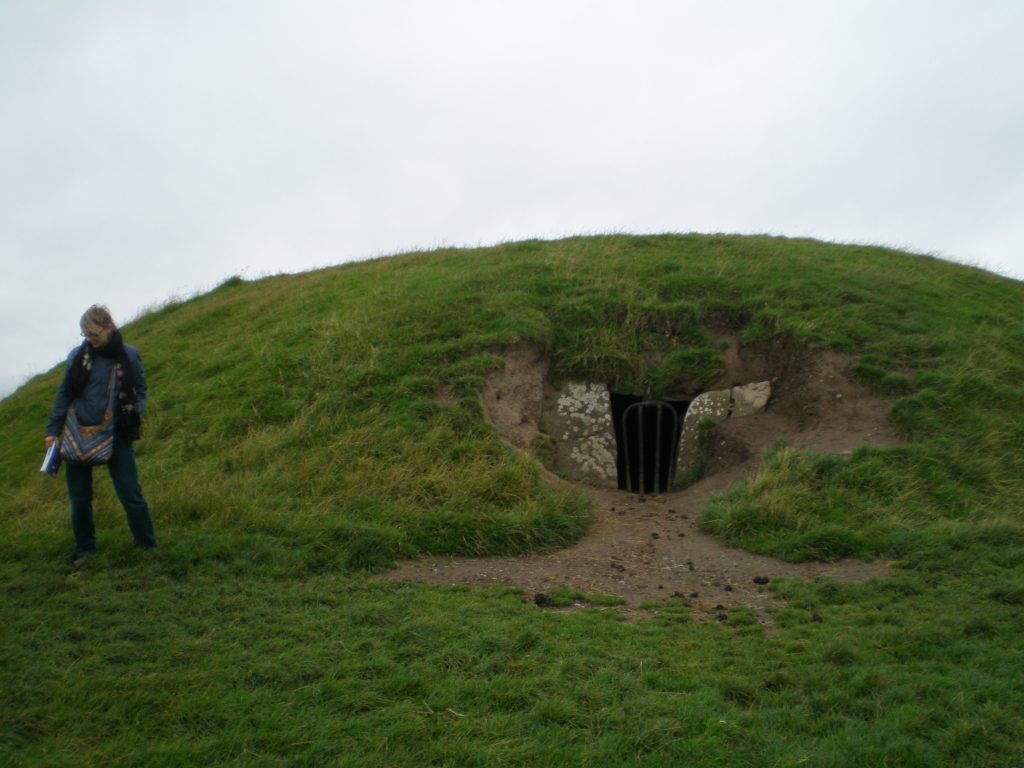
Hill of Tara,
Meath County, Ireland
Credit: Massimo Frera, 2008
Of course, some megalithic material survived in an unusual way, integrated into the walls of houses, churches, and fences. To be fair, this reuse occurred even in the Neolithic period: at the site of Locmariaquer (which we will try to visit), its famous Grand Menhir Brisé (dated to 4300 BCE)—the largest single block of stone ever erected by humans in the Neolithic, measuring 20 meters long and weighing 300 tons—fell and broke into four pieces. Perhaps due to an earthquake, or perhaps an intentional demolition caused by a political or religious change. Still in Morbihan, we have another example of menhir reuse in prehistoric times: some were knocked down to be reused as “capstones” for the burial chambers of later dolmens, as seen in the examples at Gavrinis.
Without delving for now into the construction theories of megalithic monuments, or their symbolic and religious value, let us conclude this short introductory piece by reiterating the importance of the UNESCO recognition granted to France in recent years. France was among the first countries to react to the “modern” destruction of historical monuments when, in 1889, it listed the Carnac Alignments and other major megalithic sites as protected Historical Monuments. Since then, destruction has been illegal and severely punished. Nevertheless, in 2023, an event we consider very serious occurred right in Carnac: an alignment of 39 small menhirs, classified as “secondary,” was removed and flattened to make way for a store construction site!
We will head first to Paris to spend 4 days visiting history, archaeology, and paleontology museums, and finally, we will spend 10 days in Vannes, to visit Morbihan. See you soon!