



In the megalithic landscape of Morbihan, stones were never static monuments. For roughly three thousand years (between the sixth and third millennia BCE), this region was a living landscape—a sacred theater shaped by successive elites, changing worldviews, evolving architectural styles, and genuine spiritual paradigm shifts. Nothing demonstrates this better than the Locmariaquer complex and the nearby Cairn of Gavrinis: two places separated by water yet united by an extraordinary story of engineering, symbolism, and sacred “recycling.”
Locmariaquer: The Era of Giants and the Great Catastrophe
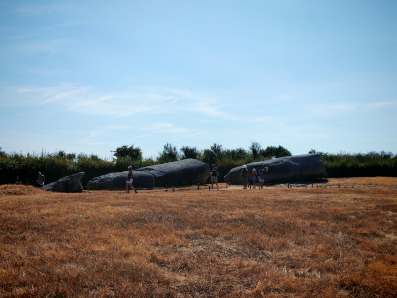
We began this phase of our exploration on the Locmariaquer peninsula, the nerve center of the first major megalithic era (5th millennium BCE). Here, lying on the ground like a sleeping giant, rests the Grand Menhir Brisé!
Standing 21 meters tall and weighing approximately 300 tons, it is the largest single block of stone ever transported and erected by humans in Neolithic Europe. Carved from a single block of orthogneiss, its quarry of origin was located at least 10 kilometers away. Moving it across the complex geography of the period—keeping in mind that the current gulf did not exist yet, but was rather a plain traversed by three major rivers—required crossing estuaries and sea channels, likely using massive barges or floating platforms crafted by joining dugout canoes together.
The Grand Menhir did not stand alone: it served as the anchor of an alignment of 19 monumental menhirs extending toward the coast, positioned right where the dry land ended and the sea was closest. Around 4300 BCE, this colossal system collapsed. While intentional destruction due to cultural or religious upheavals was long suspected, geological evidence strongly points to a violent earthquake that shattered the giant stele into four pieces.
Within the same archaeological site—accessed through a welcoming visitor center offering an introductory 10-minute film—and adjacent to the Grand Menhir lies the monumental tumulus of Er Grah, an individual passage grave stretching an impressive 140 meters in length. Excavations inside revealed prestige artifacts confirming the presence of a ruling elite connected to long-distance trade networks: among these are exquisite polished jadeite axes originating from the Italian Alps.
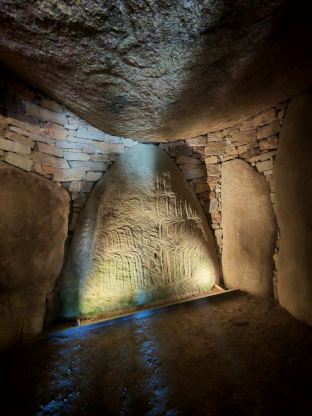
The Sacred Puzzle: La Table des Marchands and Gavrinis
When the alignments of the 5th millennium collapsed or lost their original function, subsequent populations did not abandon the monoliths. Instead, they reused them as “sacred raw material” to construct grand passage cairns.
One of the most fascinating cases of reconstructive archaeology in the world involves the massive capstone of the Table des Marchands right here in Locmariaquer and that of Gavrinis.
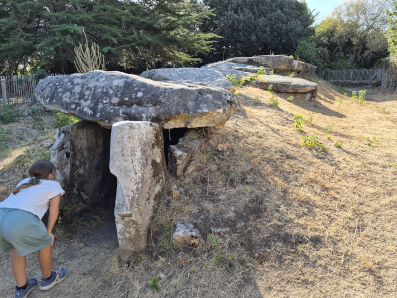
La Table des Marchands is a funerary complex located just a few meters from the Grand Menhir. Its chamber is roofed by a giant slab of orthogneiss. On its underside, carved reliefs depicting a bovid and an axe-plow are clearly visible—yet truncated. Two other fragments of the same original stone were “relocated” several kilometers away! The second piece, equal in size to the first, was incorporated into the ceiling of the Gavrinis chamber, while a third, smaller fragment was discovered at the Er Vinglé site.
When digital reconstructions aligned the three pieces, they matched perfectly. Originally, they formed a single, titanic carved stele roughly 14 meters high, erected in the Grand Menhir alignment before being felled, broken into three parts, and redistributed across the gulf.
The upper portion of the stele (weighing around 20 tons) was transported across the water to the island of Gavrinis. Archaeologists proved the feasibility of this nautical feat by building and testing double-canoe catamaran replicas capable of floating heavy loads across the gulf’s intense currents. However, experimental archaeology has so far only successfully transported stones weighing around 500 kg—a fraction of the original weight. It remains an open question whether a multi-ton stele could truly be moved using larger canoes!
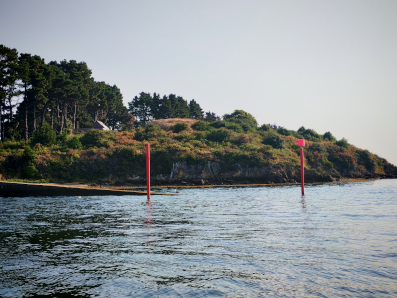
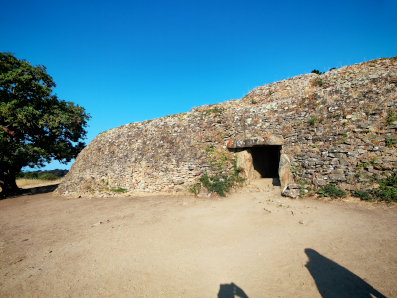
Now, it is time to set sail: at the port of Larmor-Baden, we board a boat accompanied by a specialized guide. After twenty minutes, we land on the islet of Gavrinis, accessible today only by ticket and carefully preserved for future generations. To be honest: years ago, when we decided to include Morbihan in our travels, it was Gavrinis—alongside Carnac—that convinced us! And our expectations were fully met!
Gavrinis: The Sistine Chapel of the Neolithic
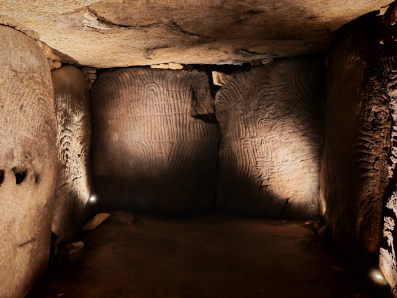
Reached by boat, the island of Gavrinis hosts a cairn whose internal passage offers an almost hypnotic visual experience.
Before going inside, we want to emphasize that, contrary to skeptics who doubt the intentional orientation of these monuments, the axis of the passage at Gavrinis shows a clear East-West alignment, designed to capture sunlight during key astronomical moments of the year.
Examining the structure reveals that one of the passage slabs features engravings of a squid/octopus motif and an axe on its upper side—completely hidden once the stone was placed in position. The presence of carved motifs on hidden surfaces indicates that many slabs were originally part of earlier outdoor alignments, later reused and over-carved with new motifs on the faces visible to visitors.
These engravings were executed outdoors in daylight before the stones were positioned. Traditional stone hammers were insufficient to carve the hard granite; artisans relied on quartz nodules, a material non-native to the site that had to be imported specifically. To cushion the violent recoil and protect their arms, workers bound the quartz to a wooden handle using animal stomach tissue as a shock-absorbing buffer.
The process was painstaking. Using a quartz hammer and a granite axe, an artisan carved at a rate of just 2 centimeters per minute. Completing a single carved slab required about a month of continuous labor, totaling roughly a year and a half to two years to finish the decorative program of the entire tomb.
The Islet of Er Lannic and the Mystery of the Waters
A short distance from Gavrinis rises the islet of Er Lannic, where megalithic history intersects with changing sea levels. The site consists of two overlapping, figure-eight-shaped elliptical stone circles (cromlechs). Today, one circle remains visible on dry land, while the other is completely submerged by the tide.
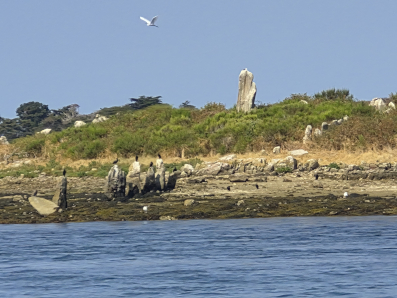
The stones of the submerged circle (the older of the two) range between 4 and 8 meters in height, whereas those of the more recent terrestrial circle rarely exceed 1.5 meters. This dramatic reduction in scale likely reflects a systemic crisis: the depletion of local resources, rising sea levels, and a potential loss of social cohesion or political centralization.
During underwater and surface surveys, archaeologists recovered over 8 kg of ceramic artifacts and 50 incense burners, testifying to intense ceremonial and votive activity linked to water or ancestor cults.
A Global Sanctuary: The “Valley of the Kings” of the Neolithic
With over 500 cataloged megalithic monuments in the Morbihan area alone, this gulf undoubtedly served as a major spiritual center of Atlantic Europe. The extraordinary concentration of tumuli, cairns, and alignments suggests a supra-regional sacred function: a true sanctuary of the dead, a Neolithic “Valley of the Kings” to which distant populations traveled to erect monuments and bury their dead in the shadow of stone giants.
To us, it feels like this landscape held a sacred magnetism comparable to Valcamonica in Italy. One archaeological theory suggests that the wealth of local “nobles” derived from the salt trade—Morbihan being one of the earliest areas to harvest salt on an industrial scale to preserve food. We like to think that one of the primary “currencies” of trade may have been participation in sacred rites and processions, much like what would occur thousands of years later with the Mystery cults of the Mediterranean.
Now, the time has finally come to head to Carnac! Let’s move!