Our journey to the land of French megaliths begins! We are taking advantage of this trip to enjoy a few days in the capital, always through the lens of ancient history.
Little remains of ancient Lutetia, the pre-Roman Celtic settlement established by the Gaulish tribe known as the Parisii (from which modern-day Paris takes its name). While some trace the origin of the name to the Latin term lutum, meaning “marsh” or “swamp”—which indeed abounded in the area—we also notice a significant root common to the ancient world. That Lu- prefix strongly evokes Lug-, the shining deity (from which “Lucifer” also later derives), which gave its name to so many ancient locations (think of Lugagnano or Liguria).
The area along the Seine River was likely marshy, but surely no ancient people would choose an unhealthy site to settle permanently. We lean toward a landscape well-suited for human life: when we recall that the earliest settlements were right on the Île-de-France, beneath what is now Notre-Dame, we realize that the island in the middle of the river was truly shining. A hidden Sun.
Julius Caesar conquered Gaul in the 1st century BCE, and the settlement developed into an important Roman center under the name Lutetia Parisiorum. Over time, it gradually took the name of the people who inhabited it, becoming Paris, likely as early as the 4th century CE.
During our few days here, we set out to get our fill of archaeology. From the mandatory stop at the Louvre (we highly recommend the Cycladic and Aegean archaeological collections) to the Musée de l’Homme, where we explored the history of human evolution and reassembled a puzzle we began two years ago in southwestern France.
We are referring to the skull of the Cro-Magnon man, exhibited here but brought to light in 1868 at a rock shelter now known as the Abri de Cro-Magnon, located in Les Eyzies-de-Tayac-Sireuil in the Dordogne department—a site we visited during our journey through Périgord in October 2023.
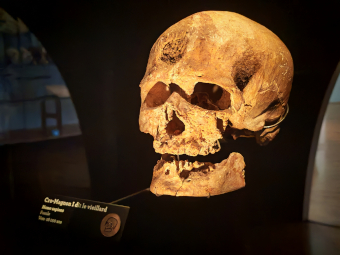
Cataloged as Cro-Magnon 1 and nicknamed “The Old Man” (Le Vieillard), this fossil provides us with the first tangible evidence of Homo sapiens in Europe. Found accidentally during railway construction, it was part of an intentional burial alongside four other adults and an infant, accompanied by animal teeth and shell ornaments. “The Old Man,” who lived during the Upper Paleolithic about 30,000 years ago, was around 50 years old at death. His dolichocephalic cranial vault, with a cranial capacity of 1,600 cm³ (larger than modern humans!), makes him as modern as he is extraordinary. High-resolution CT scans revealed that the facial bones around the forehead and eye sockets exhibit erosions (skin pitting), indicating he suffered from a genetic condition or severe fungal infection (such as Langerhans cell histiocytosis or neurofibromatosis) that caused benign tumors and destructive tissue lesions on his face.
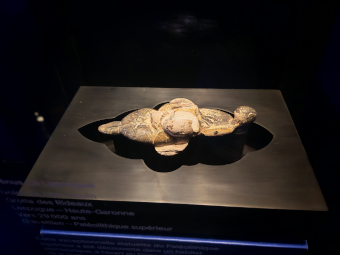
Equally thrilling at the Musée de l’Homme was observing—among other Paleolithic Venuses on display—the Venus of Lespugue! Standing approximately 15 cm tall, this mammoth ivory statuette was carved roughly 25,000 years ago and remains one of the most extraordinary examples of Upper Paleolithic portable art. It was discovered in 1922 in the Rideaux Cave at Lespugue (Haute-Garonne), at the foot of the Pyrenees. Regrettably, it was accidentally damaged by a pickaxe blow during its excavation by archaeologist René de Saint-Périer.
Later restored in Paris, its pronounced steatopygia makes it one of the most fascinating Venus figurines to survive to the present day. During the Gravettian period, these carved or sculpted Venuses connected people to a natural, feminine deity—abundant and generous, embodying fertility and Mother Earth.
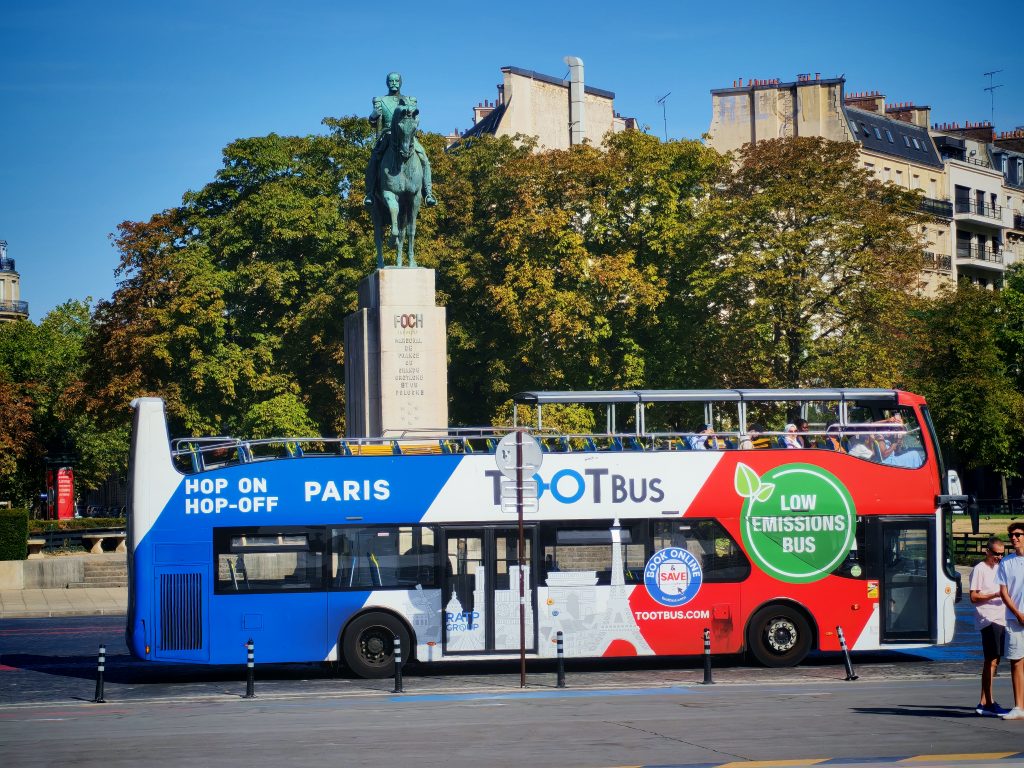
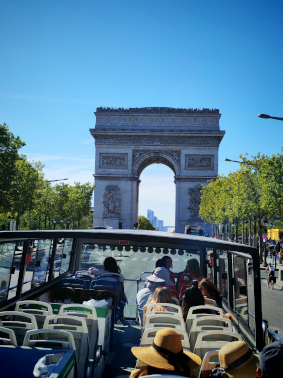
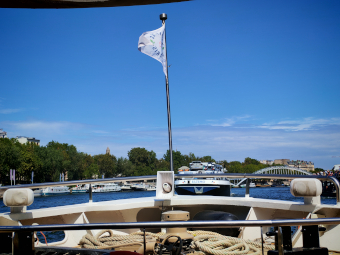
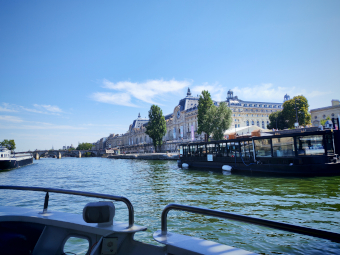
To travel between these museums, we relied on Tootbus, and it was fantastic! The low-emission bus dropped us off at key locations using their hop-on, hop-off service (with 10 strategic stops across the city, from the Champs-Élysées to the Panthéon). Thanks to the open top deck, we enjoyed incredible panoramic views of the entire city. Navigating Paris—a metropolis whose scale can be daunting for anyone wishing to travel frequently, especially families with young children like ours—has never been easier. Combining the bus tour with a cruise along the Seine (also organized by Tootbus), we were able to step into the perspective of the area’s first inhabitants, who undoubtedly navigated these very waters to deliver supplies to the Île-de-France, around which we sailed!
Finally, at the Musée Carnavalet in Paris, several monoxylon canoes (carved from a single tree trunk, such as oak or pine) are preserved. Recovered in 1922 in Bercy (Paris) and dating back to the Neolithic period (between 2700 and 2500 BCE), these ten vessels that once navigated the Seine in the era of Lutetia represent one of the best-preserved collections of prehistoric boats in Europe. Hollowed out using fire and polished stone axes, they could exceed five meters in length. When considering that the Seine was much wider at the time—up to 200 meters across—it becomes clear how essential they were for transporting people and goods.
A fantastic starting point to immerse ourselves in one of the beating hearts of Neolithic Europe: Morbihan awaits us!