



Three months in Tanzania to explore Karatu and the cultural heritage of the Rift Valley
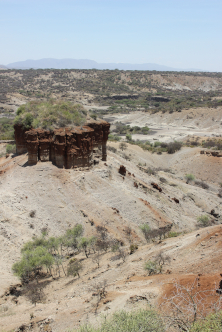
Reaching the “Cradle of Humankind” is not so simple. Traveling to archaeological sites in Africa is not as easy as in Europe. There are no suburban trains stopping near a gorge that reshaped the history of humanity. No last-minute online ticket booking. No clearly marked pedestrian entrance.
When planning my Olduvai Gorge visit, I quickly understood that logistics are part of the archaeology.
I left Italy convinced I would rent a car and move independently across northern Tanzania. Only once in Karatu did I discover the reality: there are no proper car rental agencies in town. If you want to understand how to visit Olduvai from Karatu, the answer is straightforward — you need to arrange private local transport. A driver. A vehicle used to dust roads. Someone who knows the Ngorongoro Conservation Area procedures.
Karatu is the closest base for visiting Olduvai Gorge. The drive takes approximately 2 hours and a half, depending on road conditions. But distance is not the only variable.
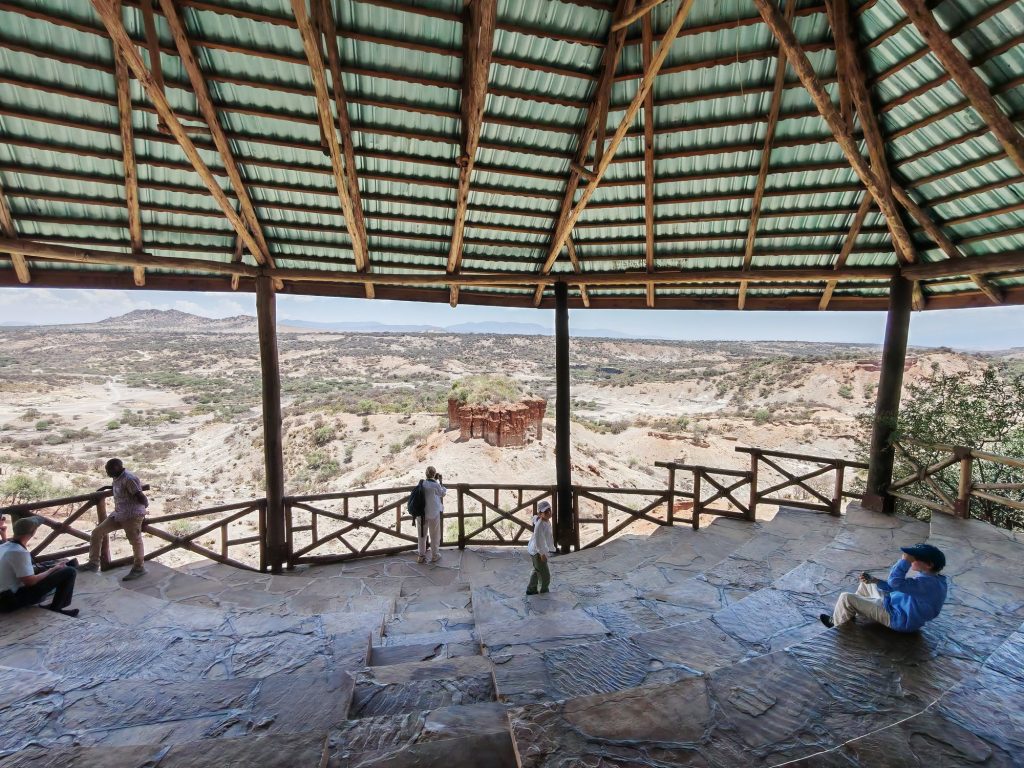
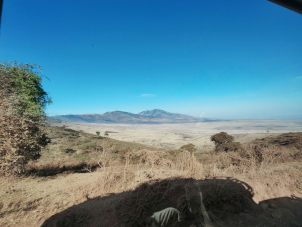
Olduvai lies within the Ngorongoro Conservation Area, meaning that access is regulated. Entry fees are connected to the broader conservation system, and procedures can change. Having a local driver familiar with the process simplifies everything — from permits to navigation across long stretches of unpaved road. We relied to a local travel agency to get entrance and driver permissions. Visiting Olduvai Gorge requires planning: from organizing transport in advance to confirming access conditions, from allowing extra time for checkpoints to bringing water and be prepared for remote conditions.
Olduvai is still under investigation. The Department of Anthropology of Rice University (Texas) or the Archaeological and the Paleontological Museum of Madrid run regular fields in this amazing site. As soon as you arrive, you realize that this is not just an archaeology field, but is a living landscape.
One of the most important things to understand before an Olduvai Gorge visit is that it is not a compact monument. It is an extended archaeological and paleo-anthropological complex with multiple areas of interest.
The Gorge and Active Excavations take place in a deep erosion cut exposing stratigraphic layers that preserve nearly two million years of human evolution.
Excavations began in the early twentieth century but became globally renowned through the work of Louis and Mary Leakey. Their discoveries — including early hominin remains and Oldowan stone tools — transformed the scientific understanding of human origins.
Research continues today. Teams still study sediments, faunal remains, and lithic industries. Standing at the rim of the gorge, looking down at the exposed layers, I felt something closer to geological vertigo than touristic admiration. This is time made visible.
Near the gorge stands the Olduvai Museum, rebuilt and expanded in recent years. It occupies the area close to the original research camp used by the Leakeys.
Here you encounter casts of fossils, reconstructions, and explanatory panels that translate complex stratigraphy into human narrative. It is the interpretative heart of the site — where scattered bones and stone tools acquire meaning.
For anyone planning a serious Olduvai Gorge visit, the museum is essential. Without it, the landscape remains silent.
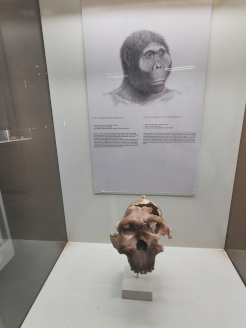
A short drive from the gorge lies one of the most extraordinary archaeological discoveries in Africa: the fossilized footprints at Laetoli. If you want to visit it you have to plan it in advance. Preserved in volcanic ash and dated to approximately 3.6 million years ago, these prints represent the earliest clear evidence of bipedal walking. The original footprints are protected and reburied for conservation, but the site interpretation allows visitors to understand their significance. Seeing where early hominins once walked transforms abstraction into intimacy. You are not looking at tools. You are looking at steps.
Olduvai is not isolated. It exists within a broader protected landscape where wildlife, Maasai pastoral communities, and archaeological heritage coexist.
This overlap deepens the experience. You drive past Maasai settlements. You cross plains shared with zebras and wildebeest. You enter a conservation system where natural and cultural heritage are inseparable. Visiting Olduvai Gorge Tanzania means accepting that archaeology here is embedded in environment, distance, and dust.
Olduvai confronts you with something different. It reminds you that human history did not begin in cities, nor in temples, nor in monumental architecture. It began in landscapes like this. And maybe the red dust on the road from Karatu to Olduvai is part of the lesson — a reminder that archaeology is not only about what we uncover, but about how we approach it.